Where was the first pyramid built, and what secrets does one of Egypt's oldest burial grounds hold? Saqqara fascinates visitors with its step pyramid of Pharaoh Djoser, the mystical catacombs of the sacred Apis bulls, and tombs filled with magnificent reliefs. Follow in the footsteps of ancient rituals and discover the stories left behind by history.
One of the oldest sites in Egypt is called Saqqara. Here you will find 15 pyramid that belonged to important pharaohs and private tombs of ancient Egyptian nobles. At that time, the afterlife meant more than earthly life. Therefore, rulers had to have appropriate shelter to enter the afterlife and were mummified so that their remains would be preserved for eternity.
The Saqqara area stretches approximately 30 km south of Cairo and lies 19 km from the pyramids at Giza. The pyramids that stand here are even older than those in Giza The site is around 7-8 km long and up to 1,800 m wide. In addition to a huge number of Egyptian monuments, the first known papyrus.
Buried here are mainly nobles from nearby capital city of Memphis. Sakkára got its name from an Arab tribe. Benny Sokar, which settled near it in the late Middle Ages. We consider the most famous building in this area to be the step pyramid of Djoser.
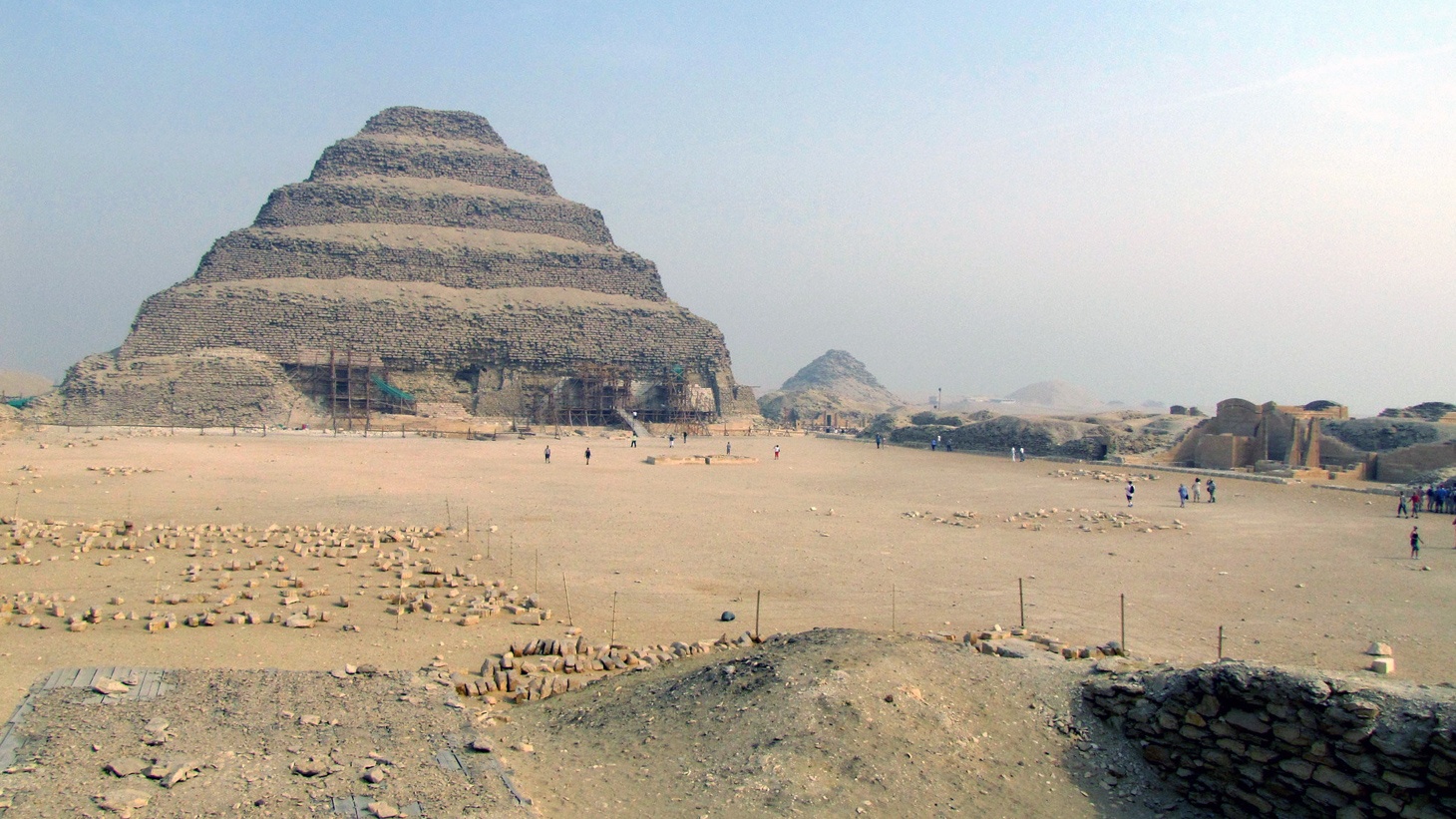
Among other things, Sakkara is home to the oldest pyramid in the world, which reaches a height of 62 m and has a base measuring 124x107 m. This is the aforementioned Step Pyramid of Djoser. It was built in the 28th century BC by the scholar and architect Imhotep. At the time, it was a truly bold architectural feat. It has six floors, which represent a kind of stairway to heaven.

Imhotep added several levels above the original mastaba, creating a step pyramid. He thus built a masterpiece that attracted attention not only for its size, but also for its cladding, which was made of polished white limestone.
Rooms were dug out beneath the pyramid, which were connected to each other by tunnels. The largest one belonged to to the ruler Djoser Although the builders blocked the entrance with a large stone block, this did not stop the robbers, who ransacked the tomb. They also stole Djoser's mummified body. Interestingly, the ruler was not buried in the pyramid, but in a traditional underground tomb.
The pyramid included a mortuary temple decorated with cobras. In Egypt, cobras were considered sacred animals and symbols of the pharaohs.
The pyramid complex also includes several temples, chapels, altars, and other tombs, which belonged to other members of Djoser's family.
He ruled during the Third Dynasty, i.e. in the first half of the third millennium, when Egypt was unified. For this reason, he wore two crowns – those of Upper and Lower Egypt. Towards the end of his reign, famine and poverty began to plague the country because the Nile lacked water. Temple archives reveal that regular floods, which allow Egyptian agriculture to flourish, are controlled by god Khnum Through prayers and the restoration of the temple of the god Khnum, sufficient water reappeared in the Nile. This phenomenon lasted for another 100 years, which is why the people considered Djoser a good ruler.
If you head further north, you will come across a small stone building in the grounds, through which you can see painted statue of King Djoser, which should correspond to his life size. Thanks to this statue, the king can allegedly communicate with the outside world even after death. However, this is a copy; the original is on display in the egyptian museum in Cairo.
In the immediate vicinity of Djoser’s Pyramid stands the Pyramid of Userkaf. It differs from the others in that it was the first to have its entrance directly from the courtyard that spread out in front of it. Inside, a basalt sarcophagus was discovered. Unfortunately, the entire complex has been heavily damaged since ancient times.
Beautiful wall paintings can be admired in several pyramids, for example in the Pyramid of Teti. Most of these inscriptions were meant to ward off danger. Some reliefs depict hunting scenes, which are particularly valuable because they provide interesting insights into animal life in ancient Egypt.
Few people would guess that where 12-meter-high ruins can be seen today, the Pyramid of Pepi I once stood. It was originally clad in white limestone, traces of which are still visible in the lower layers. Interestingly, the texts on the walls were not carved only in the burial chamber and the antechamber, but also in the access corridor. Scholars have also proven that some inscriptions were reworked from larger hieroglyphs into smaller ones, and that the name Nefersahor was changed to Meryre.

Since there was no more space in Giza for the construction of a royal complex, today we can admire Shepseskaf's mastaba Its shape is reminiscent of the mastabas of the 1st Dynasty. The entrance gate, however, resembles a pyramid and a large sarcophagus. We can speculate about why this mastaba has such a different shape. It may have been a reflection of a certain crisis of dynastic legitimacy, as some information suggests that Shepseskaf was one of Menkaure's secondary sons, but did not represent a fully legitimate successor to the famous pharaohs who had pyramids built as their eternal resting places.
Another interesting feature is burial ground of mummified bulls called Serapeum. They buried people in these mysterious catacombs. sacred bulls of Apis These animals were kept in one of the nearby temples of the god Ptah.
During excavations in the 19th century, a statue of a seated scribe was discovered. Unfortunately, the inscriptions have not been preserved, so we can only guess who it is. What we do know, however, is that scribes held a high social position, just like priests or warriors.
People believed that the bull Apis represented the earthly incarnation of the creator god and patron saint of craftsmen Ptah. Burial ensured that bulls were worshipped even in the afterlife. Bulls were mummified and their remains were stored in sarcophagi together with offerings and treasures that were to accompany them on their journey through the afterlife.
The Egyptians believed that life did not end with death. However, in order for it to continue, the body had to be properly mummified. Thanks to this, they created almost flawless mummification process.
In ancient Egypt, people buried their dead deep in the desert. The heat and dryness almost completely dried out the body, but unfortunately, it was often dug up by animal predators. For this reason, they began to use coffins, but this proved to be a bad idea because the body quickly decomposed and rotted. A better way to preserve it had to be found.
The body was first embalmed with palm wine and cleansed with water from the Nile. The liver, lungs, stomach, and intestines were placed in a natural salt solution, which dried the organs. The heart remained inside the body because the Egyptians believed that it contained human intelligence and emotion, which a person would need in the afterlife. In contrast, the brain was removed through the nostrils. All bodily fluids were then stored together with the body in the tomb.
The body was sprinkled and filled with natron, which dried it out. It was then left in this state. about 40 days Then it was possible to proceed to the mummification itself.
When is the ideal time to visit Saqqara? Open daily roughly from 8 a.m. until late afternoon. However, it is generally recommended to set out early in the morning, when the mercury in the thermometer is not climbing to high values. You will also avoid the largest influx of tourists.
Traveling by public transport is very complicated, so it is better to take a taxi. You can use Uber, or you can try a local taxi, but they are not very cheap. Try to bargain and you may be able to get a good price.
Scientists believe that there are far greater riches to be found in Saqqara than those discovered so far. When visiting, you can often see their work with your own eyes, as excavations and research activities are essentially ongoing.